Innovation in technology
Innovation in technology has always moved in waves, but few areas evolve as quickly as the intersection of digital tools and cybersecurity. Every new advancement, whether it is artificial intelligence, cloud computing, or connected devices, creates fresh opportunities for efficiency and, at the same time, new risks that need to be managed. For beginners and intermediate readers alike, understanding how these innovations fit together is the first step toward making informed decisions, whether you are protecting a personal account or overseeing security for a growing organization.
This pillar page serves as a central reference for the topic. It explains what technological innovation means in practice, why cybersecurity is inseparable from it, and how the major trends of the moment connect to one another. Each section also points toward the deeper questions you may want to explore further.
What Innovation in Technology Really Means
At its core, innovation in technology is about solving problems in new ways. It can take the form of a brand-new invention, but more often it involves improving existing tools, combining them differently, or making them accessible to more people. The smartphone, for example, was not the first mobile phone, but it redefined what a phone could do by combining communication, computing, and connectivity in a single device.
In the professional world, technological innovation tends to follow a familiar pattern: a new capability appears, businesses adopt it to gain an advantage, and security practices must then adapt to protect it. This pattern explains why cybersecurity is not a separate discipline but a natural companion to every technological leap.
The Three Main Drivers of Innovation
Most modern innovation is fueled by three converging forces:
- Computing power: processors keep getting faster and more specialized, enabling tasks that were impossible a decade ago, such as real-time language translation or advanced threat detection.
- Data availability: digital activity generates enormous amounts of information that, when analyzed properly, reveals patterns and supports better decisions.
- Connectivity: high-speed networks, including fiber and 5G, allow devices and services to communicate instantly across the globe.
When these three forces combine, they create the conditions for breakthroughs in artificial intelligence, automation, cloud services, and beyond.
Why Cybersecurity Is Central to Modern Innovation
Consider a simple analogy: a house with beautiful architecture but no locks on the doors is not truly a comfortable home. The same applies to digital systems. The more valuable and connected a technology becomes, the more attractive it is to malicious actors, and the more essential security becomes.
Cybersecurity is the set of practices, tools, and behaviors designed to protect systems, networks, and data from unauthorized access or damage. It is no longer a concern reserved for large corporations. Small businesses, schools, hospitals, and individuals all face real threats, from phishing emails to ransomware attacks. Innovation in security responds to these threats just as innovation in other fields responds to user needs.
A Practical Example
Imagine a small accounting firm that moves its client files from local computers to a cloud storage service. This innovation brings clear benefits: employees can work remotely, files are backed up automatically, and collaboration becomes easier. But it also changes the security landscape. Access now depends on passwords and account settings, and a compromised credential could expose sensitive data. The firm would need to adopt measures such as two-factor authentication, employee training, and regular access reviews. This example illustrates a key principle: every technological innovation should be paired with a security assessment.
Artificial Intelligence and Automation: The Defining Shift
Few innovations have reshaped technology and security as profoundly as artificial intelligence. AI systems can analyze vast datasets, recognize patterns, and make predictions at a speed no human team could match. In cybersecurity, this translates into tools that can detect unusual network behavior, flag suspicious login attempts, and respond to incidents automatically.
However, AI is a double-edged sword. The same technology that helps defenders can also be used by attackers to craft more convincing phishing messages, generate malicious code, or probe systems for weaknesses at scale. This dynamic, often described as an arms race, means that organizations cannot rely on static defenses. Continuous adaptation is now the norm.
How AI Strengthens Security in Practice
- Anomaly detection: AI models learn what normal activity looks like and alert teams when something deviates from the baseline.
- Automated response: minor threats can be contained instantly without waiting for human intervention, reducing damage.
- Prioritized alerts: security teams are often overwhelmed by warnings; AI helps rank risks so analysts focus on what matters most.
Zero Trust: A New Security Philosophy
Traditional security operated like a castle: strong walls around the perimeter, with relative trust inside. This model made sense when employees worked from a single office using company-owned devices. Today, with remote work, cloud services, and personal devices, the perimeter has essentially dissolved.
Zero trust architecture responds to this reality with a simple principle: never trust, always verify. Every user and every device must prove its identity and authorization before accessing resources, regardless of location. Rather than a single product, zero trust is a framework built on several pillars:
- Strong identity verification, often including multi-factor authentication.
- Least-privilege access, meaning users only get the permissions they strictly need.
- Continuous monitoring, so access can be revoked or restricted if suspicious behavior is detected.
- Micro-segmentation, which divides networks into small zones to limit how far an intrusion can spread.
For organizations of any size, moving toward zero trust is less about buying a specific tool and more about rethinking assumptions around access and trust.
Cloud Computing and Shared Responsibility
Cloud computing is one of the most impactful innovations of the past decades. Instead of owning physical servers, organizations rent computing power, storage, and software from providers. This shift reduces upfront costs, scales easily, and enables remote collaboration. Yet it also introduces a concept that beginners often misunderstand: the shared responsibility model.
In simple terms, the cloud provider secures the infrastructure, while the customer is responsible for how the service is configured and used. A misconfigured storage bucket left open to the public, for instance, is not a failure of the provider but of the customer’s settings. Understanding this division of duties is essential for anyone adopting cloud services.
Practical Tips for Cloud Security
- Enable multi-factor authentication on every account, without exception.
- Review access permissions regularly and remove accounts that are no longer needed.
- Use the provider’s built-in configuration tools to check for common mistakes.
- Back up critical data in a separate location to recover from incidents.
The Internet of Things: Convenience With Caveats
The Internet of Things (IoT) refers to everyday objects connected to the internet: cameras, thermostats, doorbells, industrial sensors, and much more. These devices bring genuine convenience and efficiency, but they also expand what security professionals call the attack surface, the total number of points an attacker could target.
Many IoT devices are designed with affordability in mind rather than security. Weak default passwords, infrequent software updates, and unclear data practices are common issues. Before connecting a device to your network, it is worth asking a few questions:
- Does the manufacturer provide regular security updates?
- Can default passwords be changed easily?
- Does the device really need internet access, or can it operate on an isolated network segment?
Treating every connected device as a potential entry point, and segmenting them from critical systems, is a simple but effective habit.
Quantum Computing: Preparing for the Next Era
Quantum computing remains an emerging field, but its long-term implications for security are significant. Today’s encryption relies on mathematical problems that classical computers cannot solve in a reasonable time. Future quantum computers may change that equation, which is why researchers and standardization bodies are already developing post-quantum cryptography, encryption methods designed to resist quantum attacks.
For most readers, no immediate action is required, but awareness matters. Organizations handling data that must remain confidential for many years are beginning to plan migration strategies, a practice often called being crypto-agile: ready to swap encryption methods as standards evolve.
Building a Culture of Security Awareness
Technology alone cannot guarantee security. The most sophisticated tools can be undermined by a single clicked link in a phishing email. This is why a culture of awareness, where every person understands basic risks and good habits, is one of the strongest defenses available.
- Learn to recognize phishing: unexpected messages, urgent language, and suspicious links are classic warning signs.
- Use unique, strong passwords stored in a password manager.
- Keep software and devices updated, since updates often patch known vulnerabilities.
- Verify requests for sensitive information through a second channel, such as a phone call.
- Report suspicious activity early, without fear of blame, so issues can be contained quickly.
How These Innovations Connect
It is easy to view each trend as an isolated topic, but they form an interdependent ecosystem. AI improves cloud security monitoring. Cloud platforms host IoT data streams that feed AI analysis. Zero trust principles protect all of these components by controlling access. And quantum research pushes the entire field to rethink its cryptographic foundations. Understanding these connections helps you evaluate any new technology holistically: what does it enable, what does it expose, and how do the pieces protect each other?
Final Thoughts
Innovation in technology is neither inherently good nor bad; it is a set of capabilities whose value depends on how thoughtfully they are adopted and protected. Cybersecurity is not an obstacle to innovation but the foundation that makes it sustainable. By understanding the major trends, artificial intelligence, zero trust, cloud computing, the Internet of Things, and quantum research, and by building strong daily habits, readers at any level can navigate the digital landscape with confidence. This page will continue to serve as the hub for deeper explorations of each of these topics in the category.

Connected watches: which functions for which uses?
The wearable technology market has witnessed a remarkable evolution with connected watches becoming increasingly sophisticated and versatile. These devices have transformed from simple timepieces to powerful wrist-worn computers that monitor health metrics, deliver notifications, and even replace smartphones for various…
Lire la suite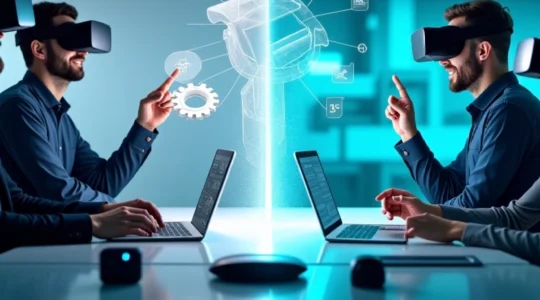
Virtual and augmented reality: an asset for businesses?
Virtual and augmented reality technologies are rapidly transforming the business landscape, offering innovative solutions to age-old challenges and creating new opportunities for growth and efficiency. As these immersive technologies continue to evolve, companies across various industries are exploring their potential…
Lire la suite
Will voice assistants revolutionize our daily lives?
Voice assistants have rapidly evolved from simple speech recognition tools to sophisticated AI-powered companions that are reshaping how we interact with technology. As these intelligent systems become more integrated into our daily routines, they promise to revolutionize everything from home…
Lire la suiteThe evolution of drones: from leisure to industrial applications!
Drones have transformed from novelty gadgets to indispensable tools across various sectors. These unmanned aerial vehicles (UAVs) now play crucial roles in industries ranging from agriculture to construction, revolutionizing how we capture imagery, gather data, and perform complex tasks. The…
Lire la suite
Boost your productivity with these innovative gadgets!
In today’s fast-paced world, maximizing productivity is essential for success in both personal and professional spheres. Innovative gadgets are revolutionizing the way we work, offering seamless integration of technology into our daily routines. From smart wearables that optimize time management…
Lire la suite